Situation
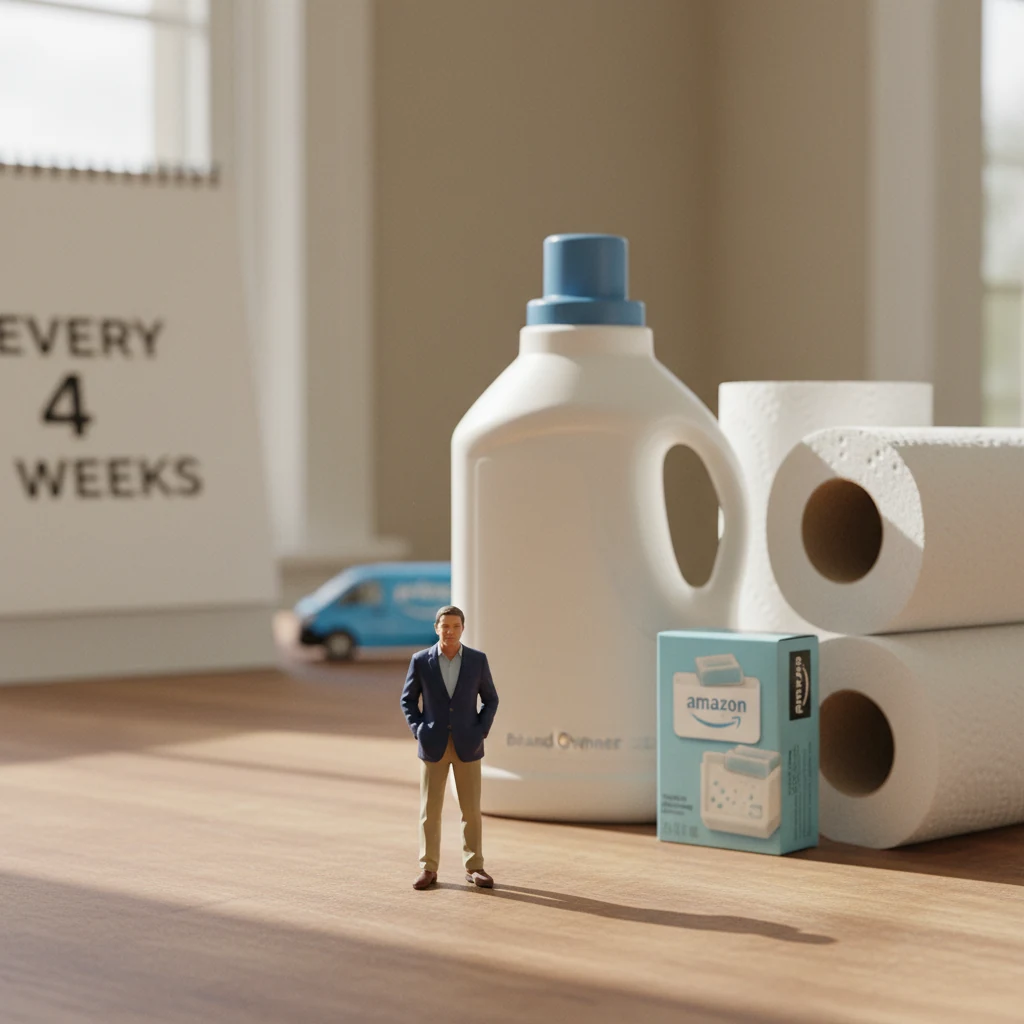
Consumable CPG brands face a specific Amazon-side dynamic that non-consumable brands don't. The Subscribe & Save program captures recurring revenue from customers who set up auto-replenishment on the product — typically 5–15% discount in exchange for a recurring subscription. For a laundry-detergent customer who buys the same brand every 6 weeks, S&S is the natural fit; for the brand, an S&S subscriber is worth materially more than a single-purchase customer over the customer's lifetime.
Amazon's algorithm preferences 1P listings for Subscribe & Save placement. Search-result positioning for S&S-eligible queries. Customer-facing discount-stack presentation. Recommendation surfaces that suggest S&S as the default purchase mode rather than a one-time buy. These placement advantages compound: S&S subscribers attached at higher rates on 1P listings generate more recurring revenue, which strengthens Amazon's algorithmic priority on those listings, which attracts more S&S subscribers.
For a brand at Persil's profile — consumable SKUs with predictable repurchase cadence, mature retail wholesale operating model that handles 1P's apparatus naturally, existing-or-aspirational Amazon Canada presence — the 1P engagement decision often centers on the S&S question specifically.
Decision
The architectural pattern for the consumable-CPG-archetype engagement: Hybrid 1P + 3P, with the 1P set explicitly chosen for Subscribe & Save compounding.
The brand identifies its consumable hero SKUs — the ones with the strongest repurchase cadence and the clearest customer-side recurring-revenue logic. Those SKUs move to 1P. The brand's other catalog SKUs — the long-tail variants, pack sizes that don't fit S&S well, promotional bundles, seasonal items, products in active iteration — continue through whichever channel already serves them.
The operational lift on Persil-class brands' side is modest because the wholesale apparatus required for 1P already exists. These are brands that ship to grocery chains and mass retailers; the Amazon Canada 1P relationship sits in the same column of the wholesale operating model. The partnership layer closes the access gap that Vendor Central's invitation-only structure otherwise creates.
The conceptual framing: this isn't a strategic shift; it's a tactical optimization on the specific SKU subset where Subscribe & Save delivers compounding value. Everything else in the catalog stays where it was working.
Results
The consumable-CPG-archetype 1P engagement, when executed cleanly on the right SKU subset, delivers a specific set of outcomes: Subscribe & Save attach rate on the 1P SKUs improves versus the same SKUs on 3P — typically 1.5–3× baseline depending on category; recurring-revenue economics on the consumable category strengthen as the S&S subscriber base on the 1P listings grows (the compounding effect over 12–24 months is the part of the case that's hardest to communicate in a single number but materially largest in total revenue); MAP across the broader retail-wholesale network strengthens as gray-market 3P sellers on the consolidated 1P SKUs lose Buy Box position; brand-protection workload on the consolidated SKUs decreases; Net 45 wholesale economics on the 1P channel match the rest of the brand's wholesale apparatus.
Specific Persil engagement figures pending verification or appropriate industry-archetype reframing.