
Scene 04
The crossroads
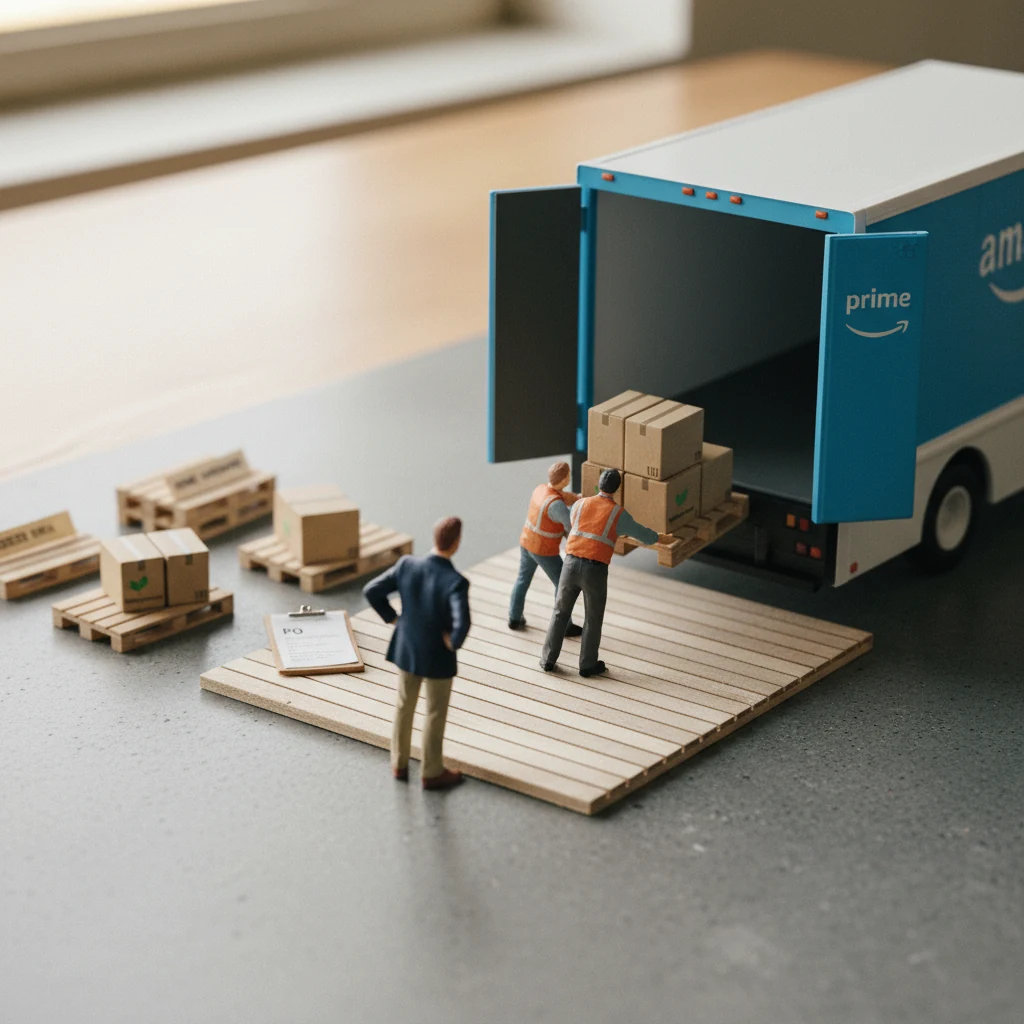
You already know how to wholesale. You write a PO, ship a pallet, and collect on terms. We're a wholesale customer that happens to operate on Amazon. We hold the Amazon.ca wholesale vendor account, buy your products at wholesale, take title, and run the Amazon channel — including the catalog setup, brand protection, listing maintenance, and 45-day payment terms — so Amazon Canada slots into the operating model you already run for your other big-box buyers.
You've probably tried, or been told by a consultant that the door is closed to companies your size. The Amazon-wholesale channel — formally called Amazon 1P (first-party), run through their Vendor Central platform — isn't something brands apply for. Amazon invites suppliers, and since late 2024 they've been actively reducing direct vendor relationships, consolidating around larger aggregated accounts. We hold that account. We've held it for years. We're an active wholesale vendor on Amazon.ca with the electronic ordering connection (EDI), the inventory feed, and an assigned vendor manager.
You already know how to wholesale. We're just one more buyer.
Not consignment. Not commission. Not 'we'll list it for you and take a cut.' We buy your inventory at wholesale, take title, hold it on our books, and resell it to Amazon. The risk on the units is ours from the moment your PO is fulfilled.
You quote us wholesale pricing the way you'd quote any wholesale buyer — case pack, FOB or delivered, minimum order quantity, payment terms. We negotiate the way Costco or Walmart would. We sign a wholesale supply agreement. We start placing POs.
Your existing apparatus carries us. Same case packs you ship to Loblaws. Same electronic ordering you run for big-box (EDI 850 purchase orders, 856 shipment notices, 810 invoices) — or email POs if you're not on EDI yet. Same minimum advertised pricing (MAP) policy. We handle the Amazon-specific layer: catalog setup, the brand-controlled image and copy section (A+ Content), Brand Registry coordination, vendor-side negotiations, chargeback disputes, and brand protection on Amazon.ca.
You stay focused on what only you can do — product, manufacturing, your other wholesale buyers, your broader channel strategy.
We're your only Amazon Canada presence. Your full eligible catalog flows through our wholesale account — one seller of record on Amazon, the default Add-to-Cart button (called the Buy Box) consistently won, and the brand-protection burden concentrated on a single accountable party. Best fit: manufacturers not on Amazon Canada yet, or whose current presence is chaotic enough that consolidation is the win.
You keep running your self-service Amazon marketplace presence (called 3P — third-party, where you list and sell directly through Seller Central). We run the wholesale-Amazon channel (1P) on a separate set of products in parallel. Each product sits in exactly one channel — no Buy Box conflict. Best fit: manufacturers with a working 3P program on the long tail who want 1P specifically for hero bestsellers, B2B-pack sizes, or daily-reorder consumables.
A hand-picked few products. Your bestsellers, your bigger items where FBA's size-based fees crush per-unit margin (FBA is Amazon's fulfillment service, which charges based on box size rather than weight), your bulk B2B case packs, your daily-reorder consumables. The rest of your catalog stays where it lives. Best fit: manufacturers who want to test the model on a small surface before deciding whether to expand.
Your existing Amazon agency keeps running your 3P program (advertising, A+ Content, listing optimization). We run the 1P wholesale channel underneath. One unified Amazon presence, two operating layers, no fee compression on your agency. Best fit: manufacturers who already have an agency they trust and don't want to disrupt that relationship.

VendorSprout is one channel inside your overall distribution strategy. We are not your Amazon strategy. The strategy belongs to you — or, if you work with an outside agency, brand consultant, or distribution strategist, it belongs to them on your behalf. Our job is to make the Amazon Canada wholesale channel work as reliably as any other wholesale customer in your portfolio. We sit alongside Costco, Loblaws, Walmart, your independent distributors, your direct-to-consumer site, and your existing self-service Amazon presence. We don't replace any of them.
| Dimension | Doing it yourself | Wholesaling to us |
|---|---|---|
| Amazon wholesale vendor access | Invitation-only — usually unavailable | Already held, active, in good standing |
| Working capital tied up in Amazon inventory | High — you fund inventory through Amazon sell-through | None — we take title at wholesale |
| Buy Box (the default Add-to-Cart) stability | Subject to unauthorized-reseller competition | Sold by Amazon.ca — structurally stable |
| Control over unauthorized resellers | Difficult; ongoing legal and Brand Registry effort | Structurally reduced — Amazon as seller crowds them off |
| A+ Content and brand-presentation work | Your team or your agency | Our team, or co-managed with your agency |
| Electronic ordering / inventory-feed operations | You build it, you staff it | We run it |
| Headcount needed for Amazon operations | 1–3 full-timers typical for active Amazon Canada | Zero |
| Payment cadence | Driven by Amazon's sell-through pace | Net 45 (we pay 45 days after Amazon confirms receipt) — predictable |
| Amazon category-manager relationship | Not available without vendor access | Carried on our account, leveraged for your products |
Manufacturer-archetype Hybrid: existing wholesale operations (case packs, electronic ordering, MAP discipline) added Amazon Canada as one more wholesale customer — no new operational headcount.
30–45 units a month to 400+ after moving one hero product from self-service (3P) to Amazon-wholesale (1P). Category rank moved from below #40 to #7.
10 to 250+ units a month with improved margins on a big-but-light product that Amazon's size-based fulfillment fees had been crushing on the self-service side.
We were spending two full-time people trying to make Amazon Canada work. Now we send a PO every six weeks and the channel runs itself. — Director of E-commerce, mid-size hardware brand
Thirty minutes. We learn your catalog, your current Amazon situation, and the wholesale relationships you already operate. You learn whether VendorSprout is a fit and which setup makes sense.
We screen your catalog for the Amazon-wholesale channel: unit economics under Amazon's vendor terms, category placement, case-pack rationalization, bestseller identification. You get back a short list of products we're confident in and a longer list with notes.
We agree on wholesale pricing, case packs, minimum order quantities, lead times, payment terms. Net 45 (payment 45 days after Amazon confirms receipt of your shipment into its fulfillment network) is our default. We sign a wholesale supply agreement.
We set up your products in our vendor catalog, attach your Brand Registry where applicable, build or migrate your A+ Content, and configure electronic ordering (EDI 850/856/810) with you — or accept POs by email until you're ready for EDI. Listings go live, inventory hasn't shipped yet.
Amazon issues us a purchase order based on forecast inputs. We issue you a corresponding PO. You ship to our designated receiving location. We ship to Amazon's fulfillment network.
Your products go live as Sold by Amazon.ca. The Buy Box is ours. Prime-eligible. From here you receive a regular PO cadence and we manage the channel without further input unless you want to be involved.
No, and in most cases it helps. Your big-box buyers care about MAP discipline and about not seeing your product undercut on Amazon by unauthorized resellers. When we operate as the Amazon-wholesale channel, Sold by Amazon.ca wins the default Add-to-Cart button, unauthorized third-party sellers lose visibility, and MAP becomes easier to defend across your entire wholesale network. We recommend a short conversation with your major retail buyers before launch so the move is framed as channel hygiene, not a surprise.
MAP on other channels stays under your control. The price Amazon shows on your products is set by Amazon's algorithm; we don't control it day-to-day. In practice, Amazon prices competitively but not destructively, and the elimination of unauthorized resellers usually improves the overall MAP picture across the rest of your wholesale network.
No. We can accept POs by email or through a shared portal. Most manufacturers we work with already have EDI for their big-box accounts; if you do, we connect 850 / 856 / 810 (the standard purchase order, shipment notice, and invoice messages) during onboarding. If you don't, we start manually and add EDI later when volume justifies it.
When the Amazon-wholesale channel is consolidated under a single authorized vendor, unauthorized listings become structurally weaker — they lose the default Add-to-Cart button, lose the Prime-eligibility advantage, and become much easier to address through Amazon's Brand Registry tools. We work with you on a Brand Registry plan as part of onboarding. We don't promise instant disappearance — that's an ongoing program — but the trajectory is clearly in the right direction.
The same case packs you ship to your other wholesale customers, ideally. We may suggest changes during product-fit review if a particular configuration creates problems on the Amazon side — Amazon's size-based fulfillment fees, multi-pack listing issues, B2B case-pack pricing. The goal is to use your existing manufacturing and pack operations as-is whenever possible.
Net 45 with favourable terms is our default — we pay you 45 days after Amazon confirms it has received your shipment into its fulfillment network. (Your product typically drop-ships from you directly to Amazon, so the clock starts the moment Amazon scans it in.) We invoice on PO fulfillment; you collect on our standard terms. We can discuss alternatives — Net 30 with a discount, or longer terms for larger commitments — case-by-case in onboarding.
We focus on consumer-physical-goods categories where Amazon Canada has scale. We typically don't take on highly regulated categories (alcohol, cannabis, prescription drugs), oversized industrial freight, or pure services. We'll tell you straight on the discovery call if your catalog doesn't fit.
Yes. Our wholesale supply agreement is terminable on notice — typical commercial terms, 60–90 days depending on inventory position. We don't lock you in. The reason most engagements last is that the unit economics make sense, not that the paper traps you.
Yes. Customer returns on the wholesale-channel units are Amazon's problem, not yours. Vendor-side chargebacks for compliance issues on inbound shipments are our problem to dispute and resolve — we don't pass those through to you.
Either. By default we manage A+ Content and listing health for the products we sell. If you have an existing agency doing this work and want them to continue, we coordinate — that's the Agency Co-Managed engagement.
If you have an Amazon agency on retainer, they typically keep their retainer for the work they're still doing (3P management, advertising, A+ Content if they retain it). The wholesale channel doesn't change your agency relationship. If you have a wholesale broker who would normally earn commission on a Costco-style placement, we treat the VendorSprout relationship the same way — broker commissions are between you and your broker, and we accommodate the customary arrangement in our pricing.
No hard minimum, but the economics work better when there's enough volume to justify the operational setup. As a rough guide: a manufacturer doing $500K+ a year of Amazon Canada-relevant volume (or with credible runway to that level) is a strong fit. Below that, we'll tell you on the call whether it makes sense to start now or revisit later.