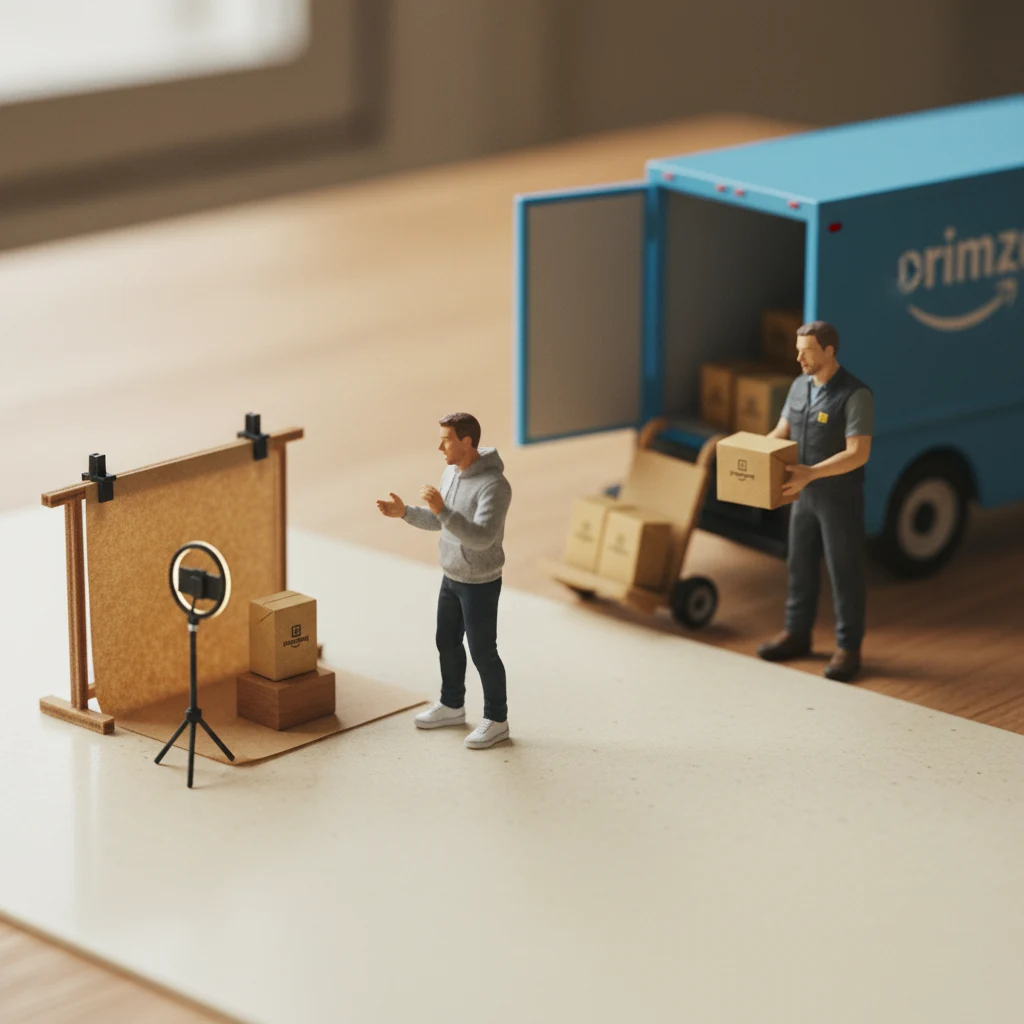
Scene 15
The studio handoff
You didn't start a wholesale operations company. You started by being good at making something people watched. We run the boring part. We hold the Amazon Canada wholesale vendor account (called 1P — first-party — where Amazon buys from us and resells to its customers), take title on the products you choose, and run the channel for you. Your direct-to-consumer site, your social, and your brand voice all stay yours — and 45-day payment terms from us help fund your next product launch.
Vendor Central is structured around traditional wholesale relationships — case packs, EDI, vendor managers, annual negotiations. The whole apparatus assumes you've been wholesaling to retailers for years. Most creator brands haven't. You came up through DTC and FBA. That doesn't disqualify you from the value 1P delivers — it just means the operational layer is unfamiliar. We've held the Vendor Central account for years. We handle the wholesale-shaped parts of the relationship so you don't have to learn them.
You stay focused on content. We become a wholesale buyer.
No. Your customer relationship lives in DTC, email, and social — where you've always built it. Amazon is fulfillment. What 1P changes is the seller-of-record line on the Amazon listing (your brand storefront → Amazon.ca) and who handles the operational layer. The customer journey from your content to your product is unchanged — they see your content, find you on Amazon, click buy. Your audience, your DTC site, your email list, your social channels — all the assets that make you you — stay yours. We're a channel partner, not a customer-relationship layer.
What that means in practice: Amazon Vendor Central as a commercial relationship — POs, ASN, AVN, chargebacks, deductions, compliance, vendor-side category-manager conversations.
Catalog setup and listing health for the SKUs we sell. A+ Content layout and refresh — you give us the voice, the imagery, the message; we assemble it into Amazon's A+ module formats so it looks right on the listing. Brand registry overlap and brand-protection cleanup against unauthorized 3P sellers on the SKUs we operate. Wholesale inventory and PO management. Performance reporting on the SKUs in our scope.
What stays with you: product development, brand voice, the Creator's voice. Content — every piece. Your YouTube, TikTok, Instagram, podcast, newsletter. DTC site end to end. Email list and CRM. The customer's perception of the brand. All the SKUs we're not operating.
You don't lose the brand. You lose the hours.
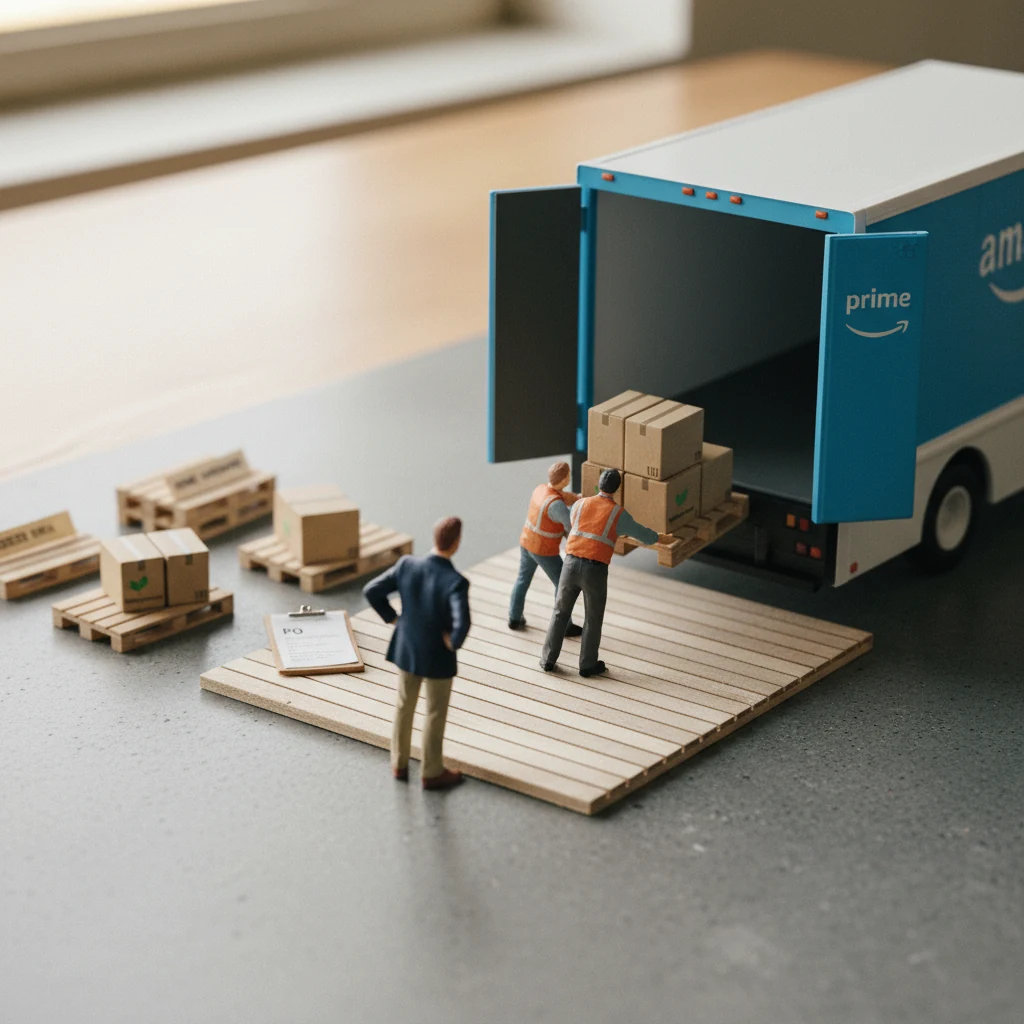
For consumable creator-brand SKUs — supplements, snacks, beauty, pet, household — Subscribe & Save on Amazon 1P is meaningfully stronger than on 3P FBA. Amazon's algorithm prioritizes 1P listings for S&S placement, the customer-facing discount stack is cleaner, and the recurring-revenue math compounds faster. Typical creator-brand consumables on 1P S&S see recurring-subscriber attach rates 1.5–3× higher than the same SKU on 3P FBA. Compounded over 12–24 months, that's a meaningful revenue layer that's hard to access any other way. If you sell consumables, this is the conversation to have on the call.
A hand-picked SKU or two through us. Everything else stays where it lives. Most creator brands start here. Test the model on one hero consumable, prove out the Subscribe & Save acceleration, expand from there. No commitment to expand.
Your existing FBA keeps running. We run 1P on a separate set of SKUs in parallel. Each ASIN in exactly one channel — no Buy Box conflict. Fit: creator brands already scaled on FBA who want 1P specifically for hero consumables or high-cube items where FBA economics punish.
We become your only Amazon Canada presence. Your FBA retires; we run everything as 1P. Fit: creator brands at scale who've decided FBA isn't where their team should be spending time, with catalog economics that justify a full move.
Your existing Amazon agency keeps running everything they run today. We run the 1P channel underneath. Fit: brands with an agency they trust and don't want to disrupt.

VendorSprout is one channel inside your existing stack. Your DTC site stays the way you built it. Your social presence stays the way you built it. Your FBA program (if you have one) stays running on whatever SKUs you choose to leave there. Your agency or in-house Amazon team (if you have one) stays in their role. What we add: the 1P channel for the SKUs where 1P pays — typically your hero consumables, your highest-margin SKUs, anything where Subscribe & Save compounding matters, anything where high-cube FBA fees are eating margin. You decide which SKUs go where.
| What stays creative (you) | What becomes operational (us) |
|---|---|
| Product development | Vendor Central commercial relationship |
| Brand voice and creative direction | Catalog setup and listing health |
| The Creator's content — every piece | A+ Content layout and refresh |
| Shopify / DTC site end to end | Brand registry overlap and protection |
| Email list and CRM | Wholesale inventory and PO management |
| Social channels (YouTube, TikTok, IG, podcast) | Chargebacks, deductions, compliance |
| Customer community and brand-side communication | Vendor-side performance reporting |
| New product launches (we onboard when ready) | Day-to-day Amazon Canada operations |
Single hero SKU switched to 1P. 30–45 to 400+ units / month. Pattern: when a creator brand has one product that drives most of the volume, moving just that one to 1P often delivers most of the available upside.
High-cube SKU FBA was punishing. 10 to 250+ units / month with improved margins. Pattern: creator-brand categories that include high-cube items (pet, supplements in larger formats, kitchen accessories) see the same FBA-fee-escape benefit.
Manufacturer-archetype Hybrid: when a creator brand matures and adds wholesale operations, the same Hybrid pattern applies — 1P becomes one more wholesale customer in the rotation.
I started this brand to make videos and ship a great product. I did not start it to spend Tuesday afternoons fighting Amazon chargebacks. Selective 1P with VendorSprout on our hero SKU gave me my Tuesdays back. — Founder, creator-led consumables brand
Thirty minutes. We learn your catalog, your audience, your current Amazon situation, and which SKU you're thinking about for 1P. You learn whether VendorSprout is a fit.
We screen your candidate SKU(s) for 1P fit — unit economics, category placement, Subscribe & Save fit, dimensional considerations. You get back a clear yes/no.
We agree on wholesale pricing, case packs (we'll help if you don't have them spec'd yet), lead times, payment terms. Net 45 with favourable terms is the default.
We map your SKU(s) to our Vendor Central catalog against the same ASIN you have on FBA, coordinate brand registry, sync A+ Content with your brand-side direction.
Amazon issues us a PO. We issue you a corresponding PO. You ship from your warehouse (or 3PL) to our designated receiving location.
SKUs go live as Sold by Amazon.ca. Your existing FBA inventory continues until depleted (or moves per the transition plan from step 3). Regular PO cadence from here. You go back to making content.
No. Your customer relationship lives in DTC, email, and social. Amazon is fulfillment. The customer journey from your content to your product is unchanged. What 1P changes is the seller-of-record line on the listing and who handles the operational layer. The customer's emotional relationship with your brand stays where you built it: with you, on your channels.
Nothing. Your Shopify (or other DTC platform) stays exactly as it is. We don't touch it, we don't influence it, we don't take a cut of it. DTC is your direct customer relationship and your highest-margin channel; we'd never recommend disrupting it.
Yes. We don't write your A+ Content from scratch — we work with your brand-side direction. You give us copy, voice, imagery, messaging guidelines. We assemble it into Amazon's A+ module formats so the listing reads on-brand. For brands with a strong existing voice, the A+ Content on the 1P listing often looks more polished than what they had on FBA.
Yes. The brand name, product photography, A+ Content, brand store — all yours, all attached to the ASIN. The only visible change to a returning customer is the Sold by line (which most customers don't notice) and sometimes the Buy Box price (which Amazon sets). The product itself is identical.
No. Reviews are attached to the ASIN, not the seller. They stay exactly as they are, and new reviews continue to accumulate.
Subscribe & Save subscriptions move with the ASIN. When a SKU transitions from your 3P listing to our 1P listing on the same ASIN, existing subscribers continue receiving their orders — fulfilled now from 1P inventory. The subscriber doesn't notice; the algorithm handles the channel reassignment in the background. Going forward, new S&S sign-ups land on the 1P listing with stronger algorithmic placement.
Yes. The Agency Co-managed engagement model is specifically designed for this. Your agency or in-house team keeps managing PPC, brand-side strategy, ranking work, off-Amazon marketing. We add the 1P channel as a parallel operational layer. No fee compression, no scope conflict.
Consumables (supplements, snacks, beauty, pet, household) — especially anything subscribable — see the strongest 1P advantage thanks to Subscribe & Save acceleration. High-cube items where FBA dimensional pricing punishes also fit cleanly. Pure-DTC categories with low Amazon overlap (custom, made-to-order, one-of-one) usually don't justify a 1P move. Fashion / apparel can work but depends on size variation and return-rate economics. We'll tell you straight on the call.
Yes — Amazon Canada specifically is one of our strongest entry points. Many creator brands have built dominant US Amazon presence and have either ignored Amazon Canada entirely, attempted to expand and found the operational layer prohibitive, or shipped chaotically from US with no Canadian inventory. We become your clean Canada channel without you needing to stand up Canadian operations yourself.
Yes. Selective engagements have launched with a single SKU. For a creator brand with one hero consumable, that's often exactly the right starting shape.
Depends on the launch strategy. Many creator brands prefer to launch new SKUs on 3P first — pricing flexibility, faster iteration on listing/copy, Amazon Vine for early reviews. After 60–90 days, once the SKU has stabilized, move it to 1P with reviews and rankings preserved. Some launches go straight to 1P — typically when the product is a line extension to an existing hero SKU and the unit economics are already understood. We discuss launch strategy on the call.
Different value. FBA's 14-day cycle is faster cash but variable and sell-through dependent. Net 45 is slower cash but predictable and front-loaded — we PO you for inventory we'll sell over the next 8–12 weeks. Many creator brands prefer Net 45 because the predictability lets them plan the next product launch with confidence.
Yes. The wholesale supply agreement is terminable on notice — typical commercial terms, 60–90 days depending on inventory position. SKUs we'd been running on 1P revert to your FBA control with a transition plan we agree on.